# Understanding client participation with oversubscribed resources in Flower
**URL:** https://discuss.flower.ai/t/understanding-client-participation-with-oversubscribed-resources-in-flower/1087
**Category:** Flower Help - Intermediate
**Created:** [August 21, 2025, 8:42am UTC](https://discuss.flower.ai/t/understanding-client-participation-with-oversubscribed-resources-in-flower/1087 "2025-08-21T08:42:00Z")
**Posts on this page:** 2
**Page:** 1
### Author:  [@griffith](https://discuss.flower.ai/u/griffith)
#### Post date: [August 21, 2025, 8:42am UTC](https://discuss.flower.ai/t/understanding-client-participation-with-oversubscribed-resources-in-flower/1087/1 "2025-08-21T08:42:00Z")
I’m running federated learning with Flower where I have more clients configured than my hardware can run concurrently, and I’m not seeing the behavior I expected.
### My Setup
- 8x NVIDIA H100 GPUs
- 32 federated clients configured (`num-supernodes = 32`)
- Each client allocated 0.333 GPU (`num-gpus = 0.333`)
- `fraction-fit = 1.0` (expecting all clients to participate each round)
- Using Flower 1.19.0 with Ray backend
### What I Expected
With 32 clients configured but only resources for ~20 to run simultaneously, I expected that each round would:
1. Start 20 clients on available GPUs
2. Queue the remaining 12 clients
3. As the first clients finish, the queued ones would get GPU resources and train
4. The round would complete after all 32 clients had trained
### What I’m Observing
To track which clients actually run, I added logging to `client_fn`:
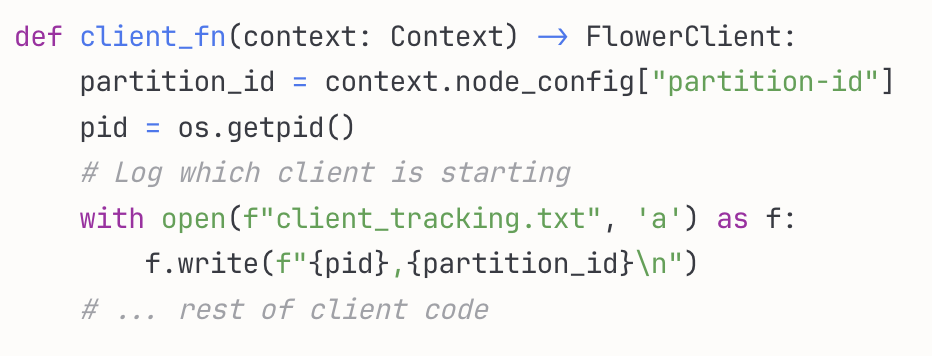
After running 10 rounds:
- The tracking file shows all 32 clients (partition-id 0-31) register initially
- GPU monitoring over the entire training period shows only 20 unique client processes ever get GPU resources
- The same 20 partition IDs run every round
- The other 12 partition IDs (0,1,2,5,9,12,14,21,22,25,27,28) never execute beyond their initial registration
Even after 10 rounds of training (over 75 minutes), those 12 clients never get scheduled to run. They seem to register at startup but then never actually train.
### My Question
Should Flower be scheduling those 12 queued clients to run as GPU resources become available within each round? Or is there something in my configuration preventing the queueing/rotation from working? I expected all 32 clients to take turns training each round (even if it takes longer), but instead the same 20 clients train every round while 12 never run at all.
Thanks for any insights on how client scheduling works when resources are oversubscribed!
---
### Author:  [@javier](https://discuss.flower.ai/u/javier)
#### Post date: [August 21, 2025, 9:20am UTC](https://discuss.flower.ai/t/understanding-client-participation-with-oversubscribed-resources-in-flower/1087/2 "2025-08-21T09:20:24Z")
Hi @griffith ,
The expected behaviour is what you mention: that all those 32 partitions IDs should be present in the `client_tracking.txt` because indeed all 32 nodes should be scheduled in a round given that you have `fraction-fit=1.0`.
When oversubscription happen, Flower uses a simple scheduling mechanism based on ray: given that you set `fraction_fit=1.0` all 32 _virtual_ clients will be executed but not concurrently (since there are not enough resources). What do you observe if you set `num-gpus=0.25` (which should make all your 32 _virtual_ clients run concurrently)?
In the [Flower Simulation documentation](https://flower.ai/docs/framework/how-to-run-simulations.html) you’ll find more details about this. And if you check the 7th video in the tutorial series, there i give a visual and informal description of how simulations work.
### A simpler test
I ran the [quickstart-pytorch example](https://github.com/adap/flower/tree/main/examples/quickstart-pytorch) on my 2x 3090 setup using this federation setup in the `pyproject.toml` :
```auto
[tool.flwr.federations.local-simulation-gpu]
options.num-supernodes = 10
options.backend.client-resources.num-cpus = 2
options.backend.client-resources.num-gpus = 0.2
```
Then launch the run as:
```auto
flwr run . local-simulation-gpu
```
Note the `num-gpus=0.2` this will ensure all nodes fit at the same time in my system (10 in total, 5 per GPU). All good. But when I change that setting to `num-gpus=0.5`, the Simulation Engine will only execute 4 _virtual_ clients/nodes at the same time (two per GPU). However, I’m still able to see all being sampled (since my `fraction-fit=1.0`). I added the same code snippet as in your screenshot at the top of my `client_fn`. All looks good.
I also increased `num-supernodes=100` to amplify the oversubscription. I was still able to see a near uniform sampling of all nodes (as expected). See below a simply histogram I did w/ `matplotlib`:
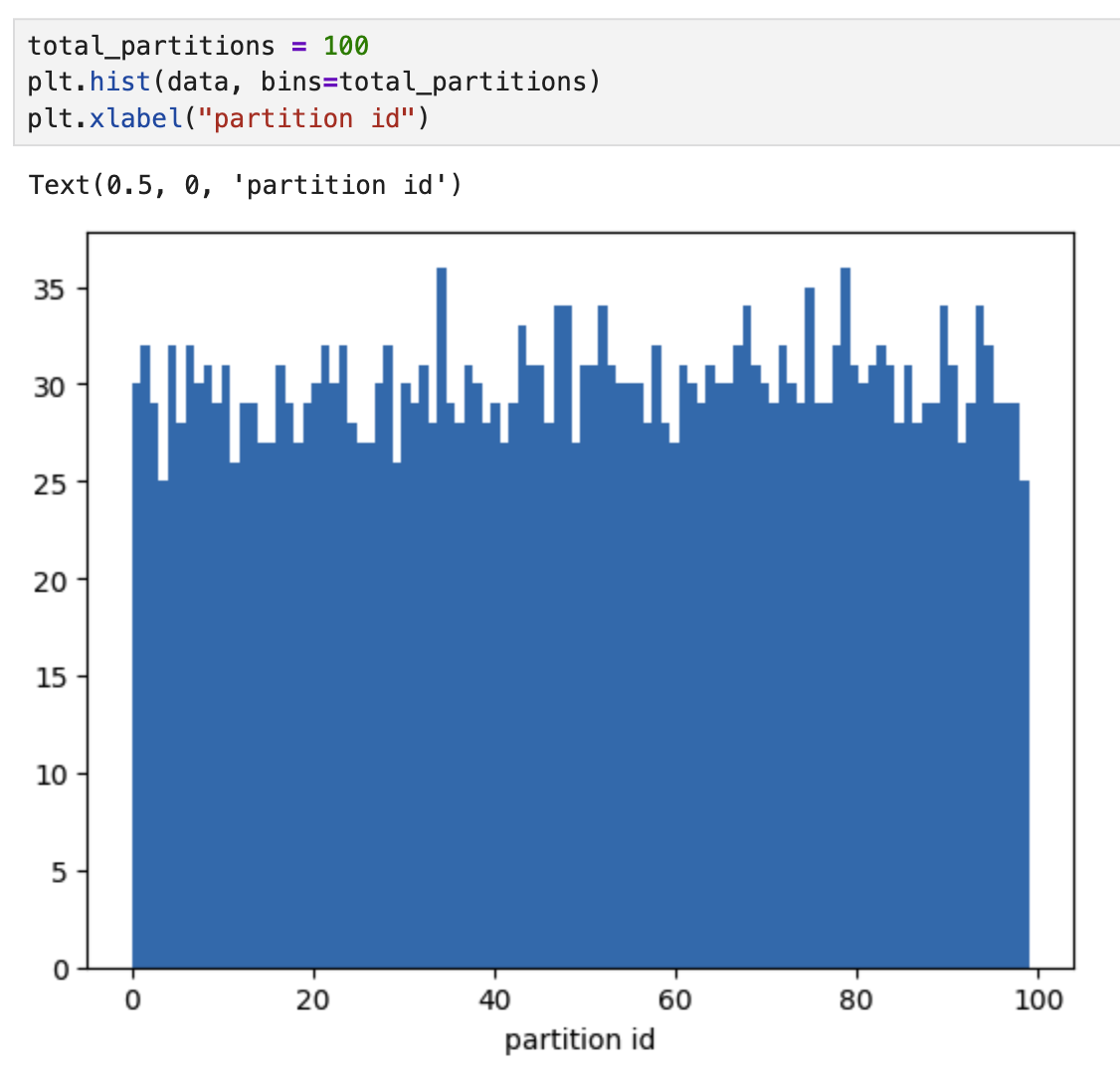
! Note part of the noise here is due to `fraction-evaluate=0.5` which only involves half of the nodes in a round of evaluate but these are also recorded in the `.txt` tracking `partitions-ids`. If we set `fraction-evaluat=1.0` then the histogram observed would be perfectly flat (100% uniform)
➡ Could you try the the [quickstart-pytorch example](https://github.com/adap/flower/tree/main/examples/quickstart-pytorch) as well and let me know if you observe the issue ?
One possibility to why you only observe 20 `supernodes` is that you aren’t setting the number of supernodes correctly? or maybe not in the federation you are actually executing?
PS: it was great reading your post. Super well structured, perfect level of detail 💯